
2026: From AI Experiments to Real Business Execution
In 2026, the conversation around AI for small and medium enterprises (SMEs) has fundamentally changed. The “next step” is no longer about experimenting with chatbots, testing prompts, or generating marketing copy for the first time. Those basics are now assumed.
The real competitive edge has moved to execution and integration.
Following the Budget 2026 announcements by Lawrence Wong, Singapore has made its direction clear: the country is doubling down on making AI practical, affordable, and usable for businesses of every size not just large enterprise with dedicated tech teams.
For SME owners, this means the question is no longer “Should we use AI?”
It is now “Where do we embed AI so it actually runs part of the business?”
The path forward can be distilled into three strategic moves. The first—and most critical—is a shift in how AI is used day to day.
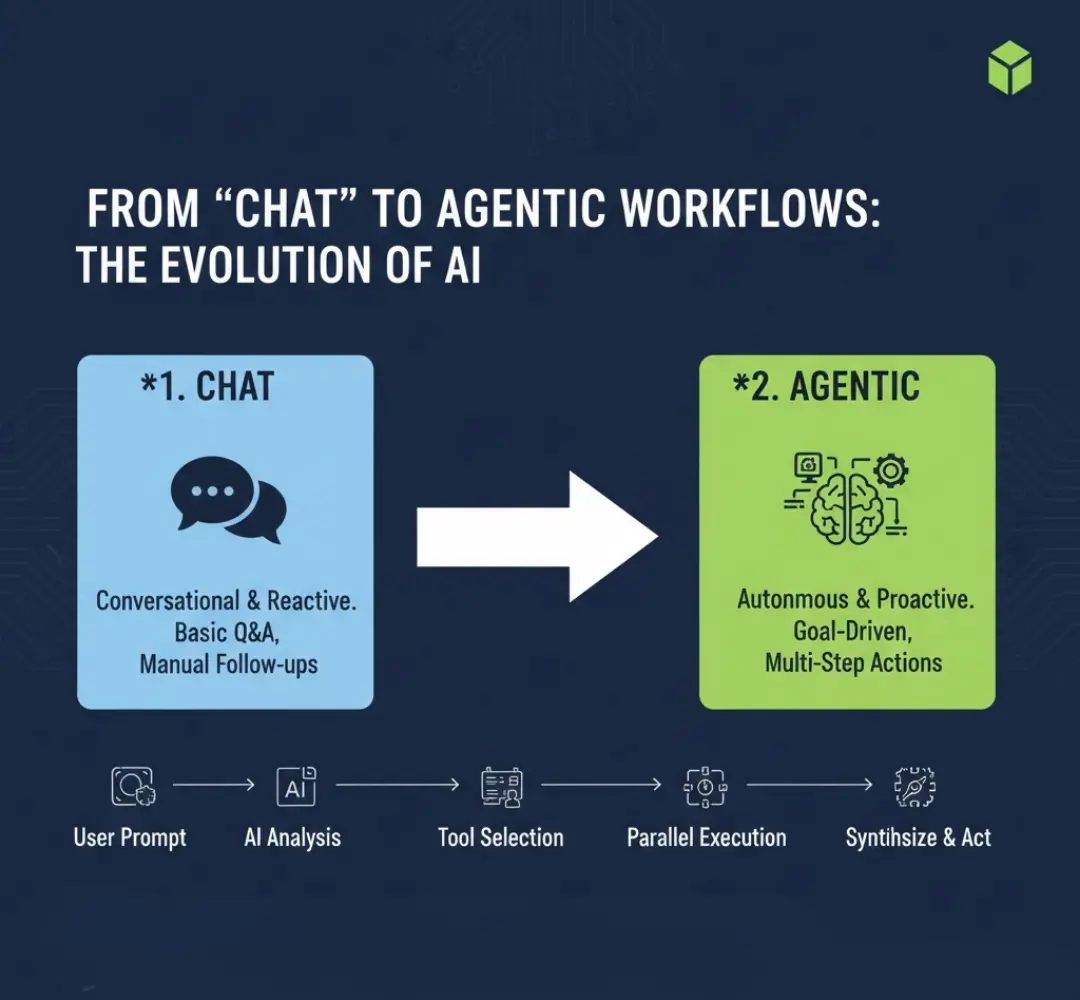
Move from “Chat” to Agentic Workflows
The most significant shift in business AI in 2026 is the rise of Agentic AI—systems designed not just to respond to questions, but to execute work.
In 2024, AI adoption for most SMEs revolved around conversational tools. Business owners and staff used chat interfaces to:
- Draft emails and marketing copy
- Generate proposals or reports
- Summarise meeting notes or documents
These tools delivered clear productivity gains, but they shared a critical limitation: they were reactive.
A human had to initiate every action, provide the context, move information between systems, and decide what happened next.
AI helped you think faster—but it didn’t actually run anything.
Why the Chat Model Has Reached Its Ceiling
Chat-based AI improves individual productivity, but it does not fundamentally change how work flows through an organisation.
Under the chat model:
- Humans still monitor inboxes
- Humans still copy data between tools
- Humans still trigger approvals and updates
- Humans remain the “glue” holding processes together
As businesses scale, this becomes a bottleneck. The problem is no longer the quality of AI responses—it is the fragmentation of execution across systems.
In 2026, leading SMEs are recognising that real leverage comes from removing humans from repetitive coordination work—not from asking them to write better prompts.
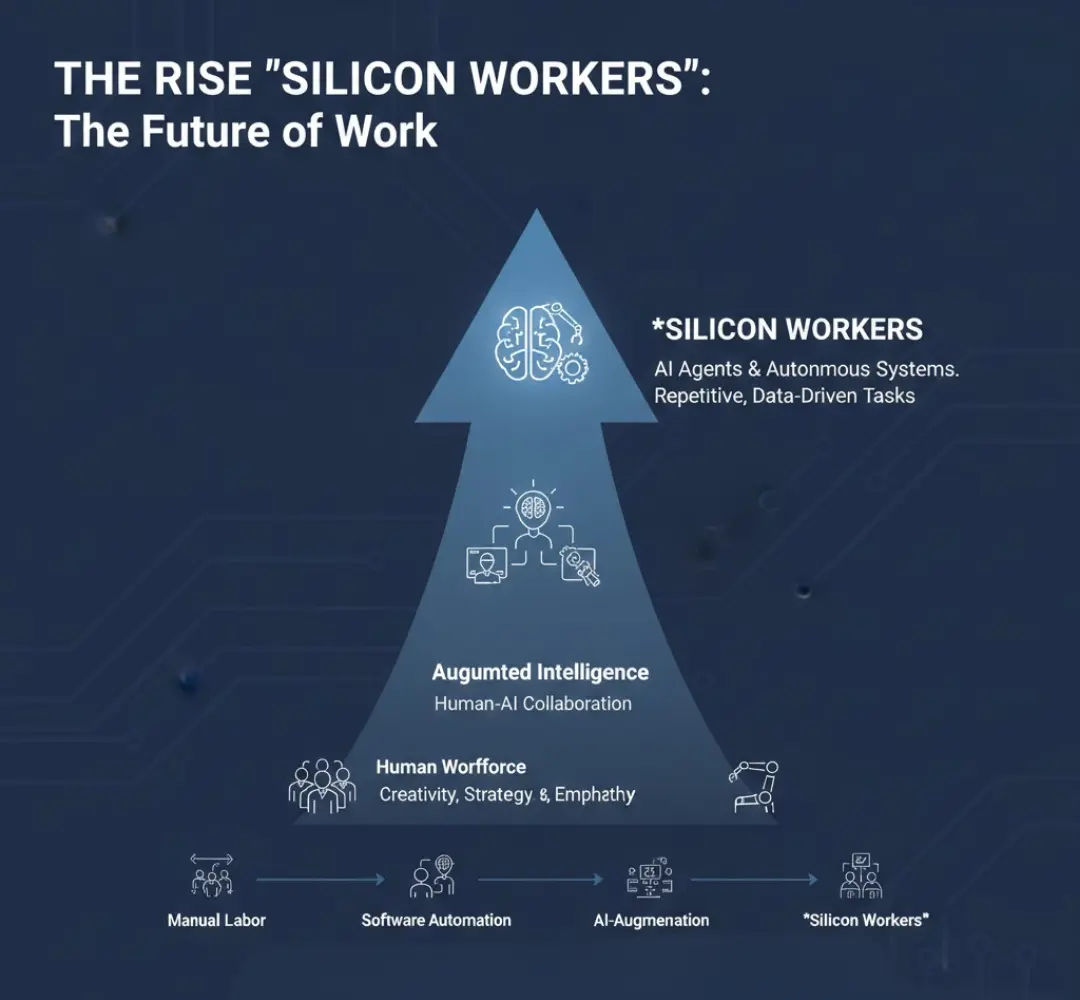
The Rise of “Silicon Workers”
Agentic AI represents a shift from AI as an assistant to AI as an operator.
These systems are often described as “silicon workers” because they behave less like a tool and more like a junior employee:
- They monitor for events
- Follow predefined rules and policies
- Take actions across multiple systems
- Escalate to humans only when necessary
Humans move from doing the task to supervising the outcome.
This is not autonomy without control; it is delegation with guardrails.
What Is an Agentic Workflow?
An agentic workflow is not AI giving recommendations.
It is AI owning a process end-to-end.
Instead of a single prompt and response, an AI agent operates in a continuous loop:
1. Observe
The agent watches for triggering events:
- A new invoice arrives by email
- A customer submits a form
- Inventory drops below a threshold
- A contract reaches a renewal date
No human needs to notice or forward anything.
2. Retrieve Context
The agent pulls relevant information from connected systems:
- ERP or accounting platforms
- CRM records
- Inventory databases
- Past transactions or documents
This eliminates manual cross-checking and copy-paste work.
3. Apply Logic and Rules
The agent applies predefined business logic, such as:
- Matching invoices to purchase orders
- Validating data against thresholds
- Classifying requests by priority
- Checking compliance with internal policies
These rules are set by humans—but executed automatically and consistently.
4. Act or Prepare Action
Based on the outcome, the agent:
- Updates records in the ERP or CRM
- Drafts approvals, responses, or reports
- Flags exceptions or anomalies
- Routes items to the correct human decision-maker
Crucially, it does this without manual intervention.
5. Escalate Only When Needed
Humans are involved only when:
- A rule is violated
- Data is missing or ambiguous
- A decision exceeds predefined authority
This turns human attention into a scarce, high-value resource, not a default requirement.
Why This Shift Matters Now
Agentic workflows are becoming viable in 2026 because three conditions now exist simultaneously:
- AI models are reliable enough to follow structured logic
- Business software increasingly exposes APIs for integration
- SMEs face rising labour costs and tighter margins
Together, these forces make partial automation insufficient. The real gains come from removing entire loops of repetitive work.
The Strategic Implication for SMEs
The competitive divide is no longer between businesses that “use AI” and those that don’t.
It is between SMEs that:
- Use AI to assist humans, and
- Use AI to replace manual coordination work altogether
Agentic workflows allow smaller teams to operate with the efficiency of much larger organisations—without increasing headcount or complexity.
In 2026, AI maturity is measured not by how well your team can talk to AI, but by how much work AI completes without being asked.
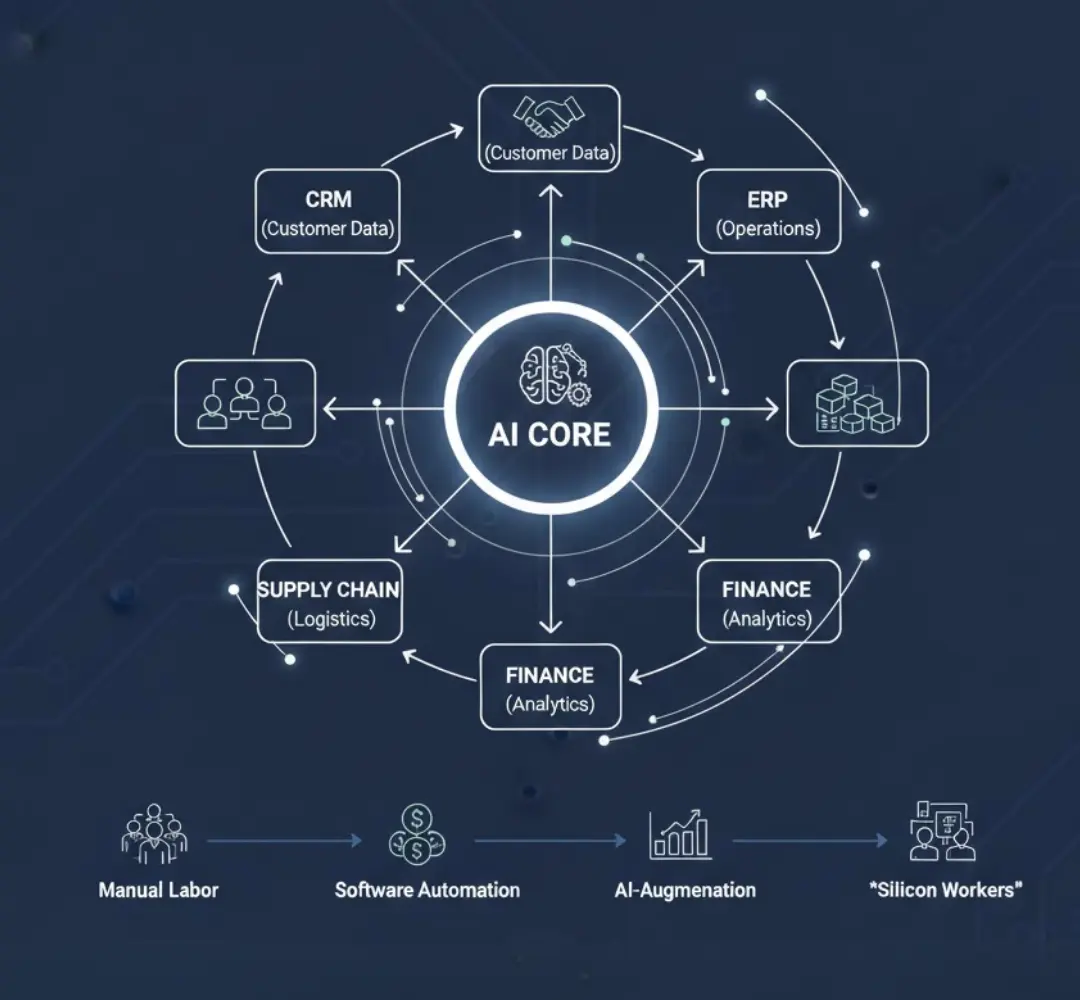
The Goal: Connect AI to Your Core Business Systems
Agentic AI only becomes transformative when it is embedded directly into the systems your business already runs on. Without this connection, even the most advanced model remains limited—able to generate insights or drafts, but unable to move the business forward on its own.
Most SMEs today operate across a fragmented stack of tools:
- ERP systems handling accounting, inventory, and procurement
- CRM platforms managing sales pipelines and customer histories
- Internal databases, spreadsheets, and shared drives
- Email, invoicing, and payment platforms
Humans act as the bridge between these systems—copying data, reconciling records, triggering approvals, and following up on exceptions. This coordination work consumes enormous amounts of time, yet adds little strategic value.
Agentic AI changes this by becoming an operational layer that sits across systems, observes what is happening, and takes action automatically based on predefined rules.
Without integration, AI is a smart assistant that waits for instructions.
With integration, AI becomes part of the business machinery itself.
Why Integration Is the Real Breakthrough
Integration allows AI to:
- See the same data humans see
- Act in the same systems humans act in
- Execute the same workflows humans execute—faster and more consistently
This removes entire classes of manual work, not just individual tasks.
Instead of asking, “Can AI help my staff do this faster?”
The better question becomes, “Why does a human need to do this at all?”
A Practical Example: Invoice Reconciliation
Invoice reconciliation is a daily reality for many SMEs—and a textbook case of unnecessary manual coordination.
The Traditional Workflow
In a typical SME, the process looks like this:
- A staff member receives an invoice by email
- Opens and reviews the document
- Manually checks it against a purchase order
- Logs into the ERP system
- Enters or verifies invoice details
- Flags discrepancies
- Prepares approval paperwork for a manager
This workflow is:
- Repetitive and low-value
- Time-consuming across hundreds of invoices
- Highly dependent on individual accuracy and availability
Errors often led to delayed payments, strained vendor relationships, or costly rework.
The Agentic Workflow
With an agentic AI connected to email, the ERP, and procurement records, the same process unfolds very differently:
-
Automatic Detection
The AI agent detects a new invoice the moment it arrives—no human inbox monitoring required. -
Data Extraction
Key details (vendor, amounts, line items, due dates) are extracted automatically. -
System Cross-Checks
The agent retrieves the relevant purchase order from the ERP and performs a line-by-line comparison. -
Rule-Based Validation
Predefined thresholds are applied:- Exact matches proceed automatically
- Minor variances are flagged but routed forward
- Major discrepancies are escalated
-
Action Preparation
The agent drafts a payment approval, schedules the transaction, or prepares an exception report—depending on the outcome. -
Targeted Human Involvement
A manager is notified only when intervention is required, with full context already assembled.
What Disappears from the Process
- No manual data entry
- No copy-paste between systems
- No chasing approvals
- No inbox-driven workflows
The keyboard becomes optional. Paperwork becomes invisible.
The Human Role After Agentic Automation
The most important change is not technological—it is organisational.
Humans no longer:
- Reconcile line items
- Monitor inboxes
- Push documents through systems
Instead, they:
- Review exceptions
- Approve high-impact decisions
- Improve rules and thresholds over time
- Focus on supplier relationships and strategic planning
Work shifts from execution to oversight, from routine tasks to judgment-based decisions.
Why This Matters for SMEs in 2026
For SMEs, agentic integration offers something uniquely powerful:
- Operational scale without headcount growth
- Consistent execution regardless of staff turnover
- Faster cycles with fewer errors
- Better use of limited human attention
In 2026, competitive advantage is no longer defined by who works the hardest—but by whose systems can run reliably on their own.
Connecting AI to your core business systems is the moment AI stops being a productivity tool and starts becoming part of how your business actually operates.
Why This Matters for SMEs
Agentic workflows are uniquely powerful for SMEs, where resources are limited and operational bottlenecks are magnified. Unlike large corporations with dedicated automation teams, SMEs rely heavily on staff performing repetitive, low-value tasks that consume both time and attention. Agentic AI changes the equation by:
-
Reducing dependence on manual labor
Routine tasks—such as reconciling invoices, updating inventory, or cross-checking data—can be automated end-to-end. Staff no longer need to spend hours on repetitive work, allowing teams to operate more efficiently without increasing headcount. -
Increasing consistency and accuracy
Humans are fallible, and errors in high-volume processes like data entry or billing are common. Agentic workflows enforce rules consistently, catching discrepancies before they escalate and maintaining uniform quality across operations. -
Freeing up skilled staff for higher-value work
When employees are relieved of repetitive tasks, they can focus on activities that drive growth: analyzing trends, improving customer experience, innovating processes, or building strategic relationships. -
Scaling operations without scaling headcount
Many SMEs struggle to grow because every increase in demand requires proportional increases in staff. Agentic AI allows businesses to handle larger workloads with the same team, effectively multiplying operational capacity without a corresponding rise in overhead.
It’s important to note that this is not about replacing people. Agentic AI complements human work by removing low-value friction from daily operations, allowing staff to contribute where their judgment and expertise matter most.
Your Next Step as an SME Owner
Adopting agentic AI is a strategic process, not a one-off project. Trying to “AI everything” at once can create complexity and overwhelm your team. Instead, approach adoption in three focused stages:
-
Identify one high-volume, low-empathy task
These are repetitive, rule-based tasks that consume time but add little strategic value. Examples include:- Data entry
- Inventory tracking
- Invoice processing
- Report generation
-
Map the task end-to-end
Understand every step the process requires:- Where does data originate?
- Which systems and platforms are involved?
- Where do errors, bottlenecks, or delays typically occur?
-
Look for agentic solutions that own the entire loop
Partial automation—where humans still manually transfer data between systems—provides limited benefit. The real payoff comes from AI handling the complete workflow, escalating to humans only when judgment or exceptions are needed.
If a process still requires humans to move information manually, it is a prime candidate for agentic automation.
The Bigger Picture
By 2026, AI maturity is no longer measured by how well your team can talk to AI but by how effectively AI is embedded into daily operations. SMEs that adopt this approach early will not only save time—they will fundamentally reshape how workflows through the organization.
Early adopters will build businesses that are:
- Leaner: Less dependent on repetitive human labour
- More resilient: Processes continue reliably even when staff are unavailable
- Structurally prepared for growth: AI scales operations without linear increases in headcount
In a competitive landscape increasingly driven by speed, accuracy, and operational efficiency, embedding agentic AI is not just a productivity improvement it is a strategic differentiator.
Contact Blue Plan.eco to start your strategic AI implementation. Let’s build the digital core that makes your business and the planet run better.